Wednesday, March 14, 2012

Travel to Victoria Falls

Another visiting faculty member from Africa University and I are leaving tomorrow morning to make my second try at getting to Victoria Falls.  Traveling isn’t easy here, however.  Here’s the story of my trip so far (and remember, I haven’t even left yet)!
There's a bus from Mutare to Bulawayo.  It leaves sometime very early in the AM, but there's no good way to find out when.  It leaves from a bus "depot", which is really just a parking lot with bus-size spaces, in the very worst part of Mutare, several miles from where I live.  There's no way to get a taxi short of walking to the center of town, and there's no good way to reserve a taxi, even by walking down there and asking someone.  It's not safe to walk at night--I'm of the opinion that the greatest danger is breaking a leg in one of the many potholes and the very uneven pavement that seems to be the norm, because although there are street lights, no one can remember when they last worked.  It's pitch black out and there's enough of a cloud cover that there won't be a moon tonight.  So a foster son of a Health Sciences faculty member will drive us to the bus depot at 3:30 am, stay with us, and make sure we get on the correct bus.

Once we're on that bus, our best bet is to try to make friends with people from Bulawayo who might be able to tell us where and when we catch a bus from Bulawayo to Vic Falls.  We're assured there is one, but that's as much as we know.  Oh, did I mention that no one knows how much either of these buses will cost?  We think the first one might be $20 or $25, and I'm guessing the second one won't be much more.

Assuming that we get on the bus to Vic Falls, our next task is (again) to make friends with anyone from Vic Falls to try to get a commitment for someone to drive us (probably for a fee, of course) from wherever the bus lets us off to the backpackers' lodging where we're staying.  I'm told that bus depots are usually on the far edge of towns, and that there will be no taxis anywhere around when we get there because most of the people riding the bus wouldn't be able to afford one, so none meet the out-of-town buses.  And, you guessed it, there's no way to phone for one.

The backpackers' lodging I chose came recommended by a friend of a friend.  Unlike most such facilities, this one has a room (not a dormitory) with 2 twin beds and a private bath.  All the others I looked at had a public bathroom down the hall.  I booked the room through the internet at a site that specializes in such accommodation.  Like Priceline and other such sites, they have you contact the accommodation directly with any questions or to change arrangements.  I emailed the backpackers' place because I needed to check on something, but it's been 4 days now without a reply, so if they actually have email, either it doesn't work or they don't check it.  The internet site gave 2 phone numbers for them.  The first doesn't accept incoming calls, and the second is out of service.

My temporary employment permit (TEP) runs out Saturday, which is a huge issue.  AU has had my passport for over a week trying to get an extension, and in the last three days I've walked across campus (because neither the email system nor the phones are working) 4 times to get it back so I'd have it for this trip.  I'm told that I'll need to walk across the bridge, go through immigration and customs there, and probably spend a night out of Zimbabwe so that I can recross the border, buy a tourist visa, and thereby extend my stay 30 days.  The university will try again to get an extension on my TEP once I get back.  Failing that, I'll have to go out of the country again mid-April.  I haven't had time to look at lodging in Zambia, since the internet hasn't been working well either at the university or on my dongel until just before I started this email.  That's next on my list of things to do this evening. 

So wish me luck.  I'll let all of you know when I get back, and whether I made it to Vic Falls this try.

Baobab Trees

I first heard of baobab trees in Rudyard Kipling’s Just So Stories (along with the green, greasy Limpopo River, which is a name I’ve always liked).   when I was a young child.  On the way to see the Great Zimbabwe, we passed through an area that had quite a few, and I really enjoyed seeing them.  They’re pretty large, and unusual in that they have very fat trunks.  (The ones we saw weren't nearly as large and fat as they can get.)  These trunks hold an amazing amount of water—I read in my favorite scientific annals, Wikipedia, that a large one can hold 32,000 gallons!  This is very adaptive in times of drought.  As the trunks get bigger, a hollow is formed in the middle, which can become home for animals or even a person.  The baobab doesn't live as long as the oldest bristlecone pines, but a few specimens have been dated at close to 2000 years old.  The baobab is sometimes called the upside down tree because for most of the year it doesn’t have leaves (more water conservation, I’ll bet), so the empty branches and twigs kind of look like a root system.  We were lucky--at this time of year, the trees have leaves.
Baobab tree in its natural state
The first few baobabs we saw were in their natural state, but then we saw quite a few that had had their bark stripped off in large rectangular patches.  We stopped so I could take a photo of one.
Baobab tree with bark trimmed
We were wondering why anyone would strip the bark, but within a couple of miles it was evident, because there were a lot of rugs and mats for sale along the edge of the road.  I later found out that the fiber of the bark is naturally fire resistant, so it makes good mats and rope.  Here’s a photo of some of the mats. 
Baobab rugs

Monday, March 12, 2012

Thoughts about Some Aspects of University Finances

Yesterday I talked more with a faculty member about a seminar she wants us to develop.  Whereas I’ve worked with organizations that want to educate the community and are willing to do training on a shoestring budget, she explained that here the whole point of doing a seminar is to bring in money to the university.  According to her, the attitude is that there’s money out there, and the goal is to get as much of it as possible for the university.  The way that’s done is to try to interest non-governmental organizations (NGO’s) in funding the seminar.  This involves paying the presenter (actually AU, not any individuals) for developing and giving the seminar.  Then the NGO needs to show its board that there’s need for the seminar and that people will attend it, so they often pay participants to come sit through it.  Sometimes this is extravagant—they’ll foot hotel bills for people coming from Harare to Mutare or vice versa as well as paying generous stipends for expenses (gas, meals) for all participants.  The faculty member said sometimes people appear for seminars well aware of the money they’ve been promised but with no idea (or care) about the content of the seminar.  We’ve decided to proceed by talking to her contacts about what kinds of training they need, and then developing a pilot test that would be done on a shoestring.  This might eventually lead to funding if  the dean wants to market our seminar to NGO’s once we’ve developed and tried it.  I was clear that I have no interest in doing that in the time frame I’m here.
Today one of my students came to see if I had any idea how he could continue to finance his education.  He’s Zimbabwean and is in my undergrad class in the Health Sciences Management program, which is 3 years.  This is his second year.  A number of people contributed to pay his tuition the first year.  Last semester he paid all but $40. He was unable to take some exams with his class last term because of that $40 deficit, and he hasn’t been able to pay registration this term.  He now owes $1770 total.  He’s been told that some scholarship money may be available to help him during the last year of his program if he gets to that point, but his benefactors have said that they can’t continue to pay for his tuition, and have encouraged him to go to a public university (where tuition is more like $400/term, according to him).  However, none of the public universities has a similar degree program, so he’d have to switch majors and essentially start over.  I really feel for the students.  I’m sure this happens in the US to some degree too, but I don’t think it’s desperate enough or structured such that faculty are very aware of it.  Another faculty member is getting lists of students’ financial status from the bursar’s office because she can’t sign off on attachments for them unless they’ve paid at least ½ the semester’s tuition.  It’s down to the wire now, and many students still haven’t been able to come up with the all the money.  What’s that saying?  “For the lack of the nail, a shoe was lost.  For the lack of a shoe, the horse went lame. . . .”   I don’t remember the rest of it, but a lot of what happens in Africa seems like that.  For the lack of a quick test, that 54-year-old woman see earlier blog about health issues in Zimbabwe) died of malaria.  It’s sad.

Friday, March 9, 2012

Communication Woes

We had the electricity go off at Africa University last Thursday (3/1), which is nothing unusual.  However, workmen had recently connected a number of separate generators so they could work in a coordinated fashion for whatever parts of campus lacked electricity.  The newly modified generators came on, then failed.  I'm not sure how that took the university computer server down (maybe there was a big power surge), but the upshot was that the server went down and has been corrupted, so we had no internet access and no email for a week. 

In January, the campus telephone system was being upgraded when a big bolt of lightning hit campus and destroyed most of the phone system.  University officials are still working to get someone to come in, probably from another country, to see what is salvagable and to decide what to do next about the telephone system.  In the meantime, very few telephones are working.  (I haven't had a working phone in my office at any point since I got here--there's only one on my floor of the Health Sciences Building that works.  This isn't important for me, but is for people who are running labs in another building or working to create attachments for students and supervise students in attachments scattered through this province.) 

For a week, official university communication has been by word of mouth or hand-delivered notes.  I found out about a required all-faculty meeting Tuesday of this week only five minutes before it was to start!

About 8:15 yesterday morning (3/8), I went over to the Information and Computer Technology (ICT) office and re-registered my user name and password, so now I have internet access again at the university.  However, everyone who had saved documents to their university computers can't access them, and it was not immediately clear whether they'll ever be recoverable.  I don't think the university has a regular system for backing up files, so there was fear that they might be gone permanently.  By today ICT has figured out how to get the documents back, but is having to go office to office to do that.  We don't have email yet, and there's not much hope for recovering anything that was saved in the email system.  Also, everyone's address books were lost.  So we all start from scratch, whenever they get the email part of the system running again.

Somone asked me about personal communication.  I have a cheap cell phone, for which I have bought a few minutes of call time.  Like most people here, I communicate mainly by instant message, since that doesn't cost money and calls cost by the minute.  The system has frequent breakdowns--I'd say that about one in four messages that I try to send won't go through on the first try, though they usually go within the first half hour.  I also have another phone, for which I buy gigabytes of time on the internet on a pay-as-you-go basis, since there's no computer connection at my apartment.  This connects me to a broadband network.  It works about 3/4 of the time when I try to get on it.  It's OK for looking up information pretty consistently.  It's fast enough to connect with the Cox Network for email about 1/2 the time.  Skype works about 1/3 of the time, without video and with some interruptions and needs to reboot, again because of the connection being too slow to sustain a call. 

Everyone adjusts to the vagaries of communication technology here pretty well.  After all, what's the alternative?  A few people have their own wi fi connections, but it's difficult to get those.  People have to provide proof of residency and utility bills for the past six months, get a letter from their employer, etc.  I could never fulfill their requirements in the time I'm here.  I'll appreciate my Android and my reliable internet connection when I get back home!

Thursday, March 8, 2012

The Great Zimbabwe

Guide, Phillip, at the entrance to The Great Zimbawe
Last Friday I went with two other Americans to see the Great Zimbabwe, the best of the historical ruins in this country, and the basis for the country’s current name.  Zimbabwe means “great stone house”.  It refers to a royal complex built by the Shona for their kings.  The site was occupied beginning in the early 1200’s AD, and continued to be occupied through the 1500’s.  At its height, the population of the urban area was in excess of 100,000 people.  The mud and thatch structures are long gone, of course.  What remains is the kings’ quarters, meticulously built on top of a large granite hill using “dry” stone construction.  That means that rocks were fitted together without benefit of mortar.

The lower, wider part of the approach to the king's quarters
The approach to the kings’ quarters was ingeniously designed.  A person approaching had enough steep steps to climb that even a conditioned warrior would be winded and fatigued by the time he reached the top.  The walls were built to form a kind of winding chute, which is narrow enough that people had to enter single file.  Warriors above could simply drop stones on any unwanted visitors.  The walls were at least 7 meters high.  At the base, they are about 5 meters wide, and would have tapered to more like 3 meters wide at the top.  Within the hill compound are spaces where traditional mud and thatch huts would have been placed.  The kings stayed there, and so did their advisors, fortune tellers and iron workers.  The iron workers’ jobs were considered so important that they were not allowed to marry, and were placed in the hierarchy of the structure pretty close to the king.
The higher part of the approach to the king's quarters
the flat rock to the right is the king's balcony,
which has a wonderful panoramic view of the countryside

The entrance to the hill compound (after climbing all those steps)
the top structures are symbolic granaries
one area of the hill compound
This was a polygamous society, and given the kings’ stature, they were expected to have many wives (estimated to be 200 or so per king).  There was a whole separate compound, currently called “the enclosure” at the base of the hill where the wives stayed until called to the hill compound by the king.
the enclosure, viewed from the hill compound
walls in the great enclosure, more recent one on left
There is evidence both in the hill compound and the enclosure that kings outdid their predecessors in opulence by enlarging and/or improving structures.  In the hill compound, where space was limited, there are signs that different kings took down the walls of previous structures, laid a new floor, and then rebuilt.  In the enclosure, walls were built around walls, forming corridors.  Each successive outer wall was more sophisticated in building style than the last, so it’s easy to see changes in technology here.

 Finally, there was another set of walls built in the valley that are believed to have been a visual representation of the continent of Africa and the Shona migratory route from the north to this area.  I’ve never seen anything like that before.

map of Africa and model village seen from hill complex
 In the valley, there was a small constructed village with crafts for sale and some people who played drums, sang and danced traditional dances.  The dancers wore pairs of large gourds with some small stones in themaround the calfs of their legs.  When they danced, these made rhythmic sounds, but I couldn't figure out how they could dance without tripping on them!
Shona drumming and singing

Wednesday, February 29, 2012

Malaria in Mutare

I’m told that malaria is not usually as much of an issue in the highlands, where Mutare is, than in the rest of the country.  Most people identified iwith malaria in and around Mutare have recently been in the lowlands, and are presumed to have been exposed to it there.
 My experience with mosquitoes has been in the US Midwest, where the hotter and more humid it is, the more mosquitoes there seem to be.  Here it’s a bit different.  I got about four bites my first week, then only one in the next three weeks.  However, when the evenings began to get a little cooler (in the 70’s in my apartment at bedtime, as opposed to the low to mid 80’s), the mosquitoes seemed to proliferate.  I’m not sure why that would be—I didn’t notice any difference in the amount of rain we were getting or anything else that would account for it.  Maybe mosquitoes like it in warm apartments on cooler evenings.  Along with the proliferation of mosquitoes was news that within a two-week period, three people I know (2 from home group/Bible study and one who is the owner of the garden restaurant I’ve been to twice) got malaria without leaving Mutare.  That has people a little concerned. 

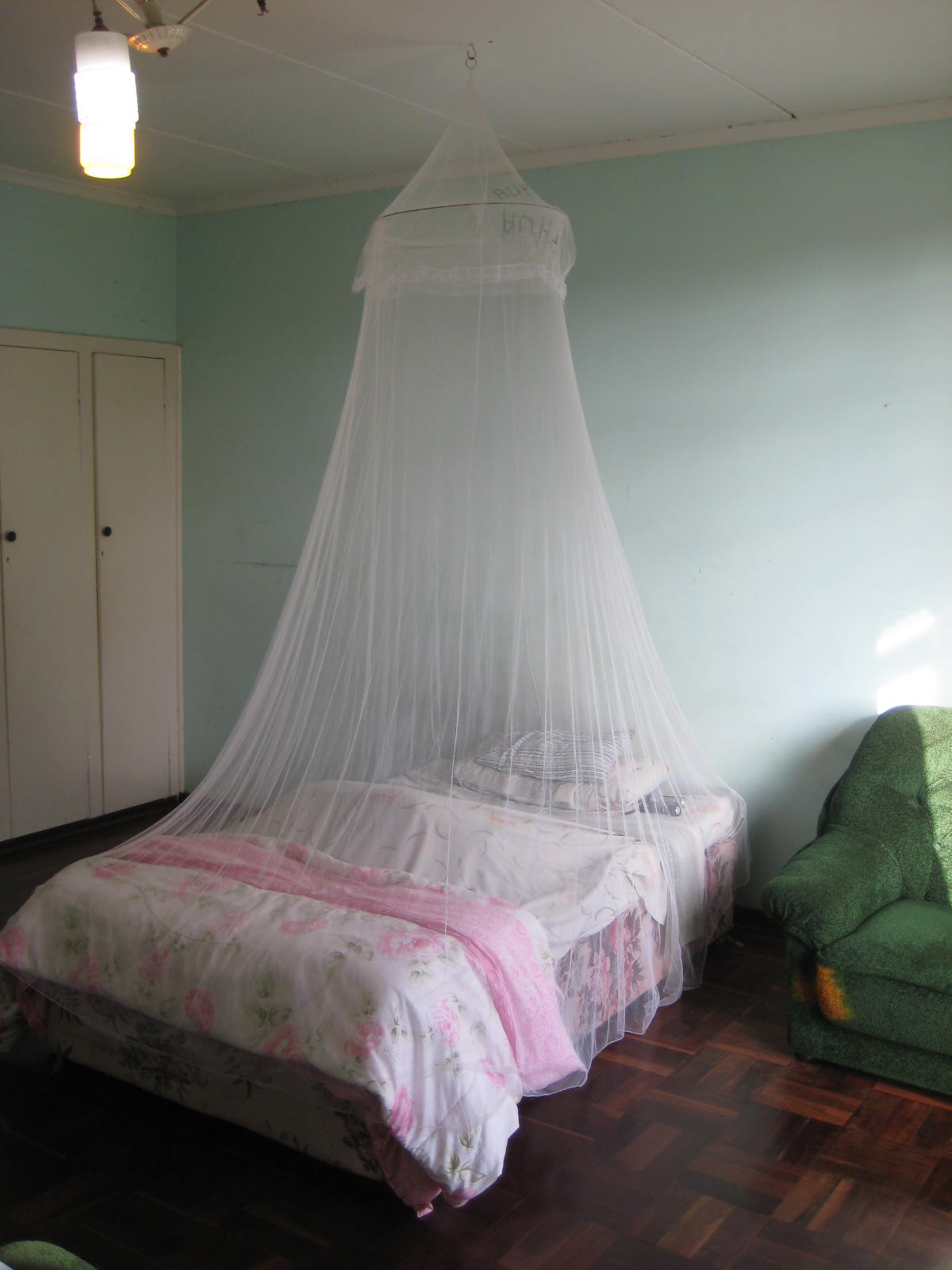
My pastor’s wife, who was over at my apartment, pointed out that I had a mosquito hook on the ceiling (I didn’t know that was what it was), and asked if I had a mosquito net.  I do—it had been sitting in the bottom of my closet ever since I got here.  So I got it out, stood on my rickety chair, and used one of my very expensive hangars as an extension to get it onto the hook.   Sleeping under it took a little getting used to--it usually touches the top of my head, and that felt like something was crowding me the first couple of nights.  It holds heat a little, so I'm glad the nights are a bit cooler.  I must admit that since I've been sleeping under it, I do a lot less bug slapping.  I thought you might like to see what my bed looks like with the net on it.  I call it my “princess bed” and think of Carla’s daughter, Lexy, when I look at it!

Shona Customs Related to Reproductive Health

One of the projects we’re doing in my graduate class is comparing information related to reproductive health in various cultures.  The class decided that each person would pick one country to become an expert on, and that they wanted me to model what I wanted them to do for each step of the project.  This seemed reasonable to me because I’m asking them to really think through reproductive health issues in cultural, family, social, scientific, political and economic contexts, and they come from an education system that traditionally relies more heavily on memorization than on reasoning and applying knowledge.  I agreed if I got to pick the country first, and I picked Zimbabwe.    As a result, I’ve been learning a lot about how the health system is structured here, and how it is viewed by people, particularly more traditional people in the rural parts of the country.  Sixty-three percent of Zimbabweans live in rural areas, so there are a lot of those folks.  Of the people living in Zimbabwe, 82% are Shona.  One part of the assignment was to learn about cultural practices that would affect people’s use of medical clinics and hospitals, or their reproductive health.  I learned some interesting things, and thought I would share them with you.
Zimbabwe has a high rate of neonatal mortality (24 per 1000 births, compared to 4.2 for the US), and is trying to improve that figure by having more women deliver in clinics or hospitals where there are skilled medical attendants for deliveries.  A significant barrier is that it a Shona custom to deliver the child, particularly a first-born child, in the home of the mother’s mother.  Shona will travel from Mutare or Harare, where good medical care is nearby, 50 km or more to a rural area with no running water or electricity to have that baby, because to do otherwise would be disrespectful of the maternal grandmother of the baby. 

 There are two other Shona customs that can impact reproductive health in this time of HIV/AIDS.  Traditionally, if a woman becomes a widow, she will be offered a choice from among the brothers of her deceased husband who are willing to have her as a wife and to assume responsibility for any children she has.  Reciprocally, if a man becomes a widower, he is allowed to ask for another woman from his deceased wife’s family (or her family may offer him one) as a replacement wife.  These customs have served to guarantee the viability of the nuclear family of the surviving spouse.  With the current high rate of HIV/AIDS infection, and the fact that most individuals don’t know their HIV status or have money to be tested for HIV, this is a conundrum for individuals whose spouse has died.  If a widow marries a brother of her deceased husband, she may bring HIV to his family (he may already have a wife and children, so she would be an additional wife).  With so many individuals of childbearing age dying from HIV/AIDS, there is often an underlying question when someone dies in that age group whether HIV/AIDS was a factor in the death.  That concern and a trend toward greater gender equity have undermined this custom, and increasingly people are waiting to choose whether and whom to remarry.